
The ensemble was founded in Pécs in 1988 by young people from the city and its surrounding region, with the aim of collecting, researching, presenting, and preserving the music, costumes, dances, and folk customs of the South Slavs (Croats, Serbs, and Slovenes) living in Hungary.
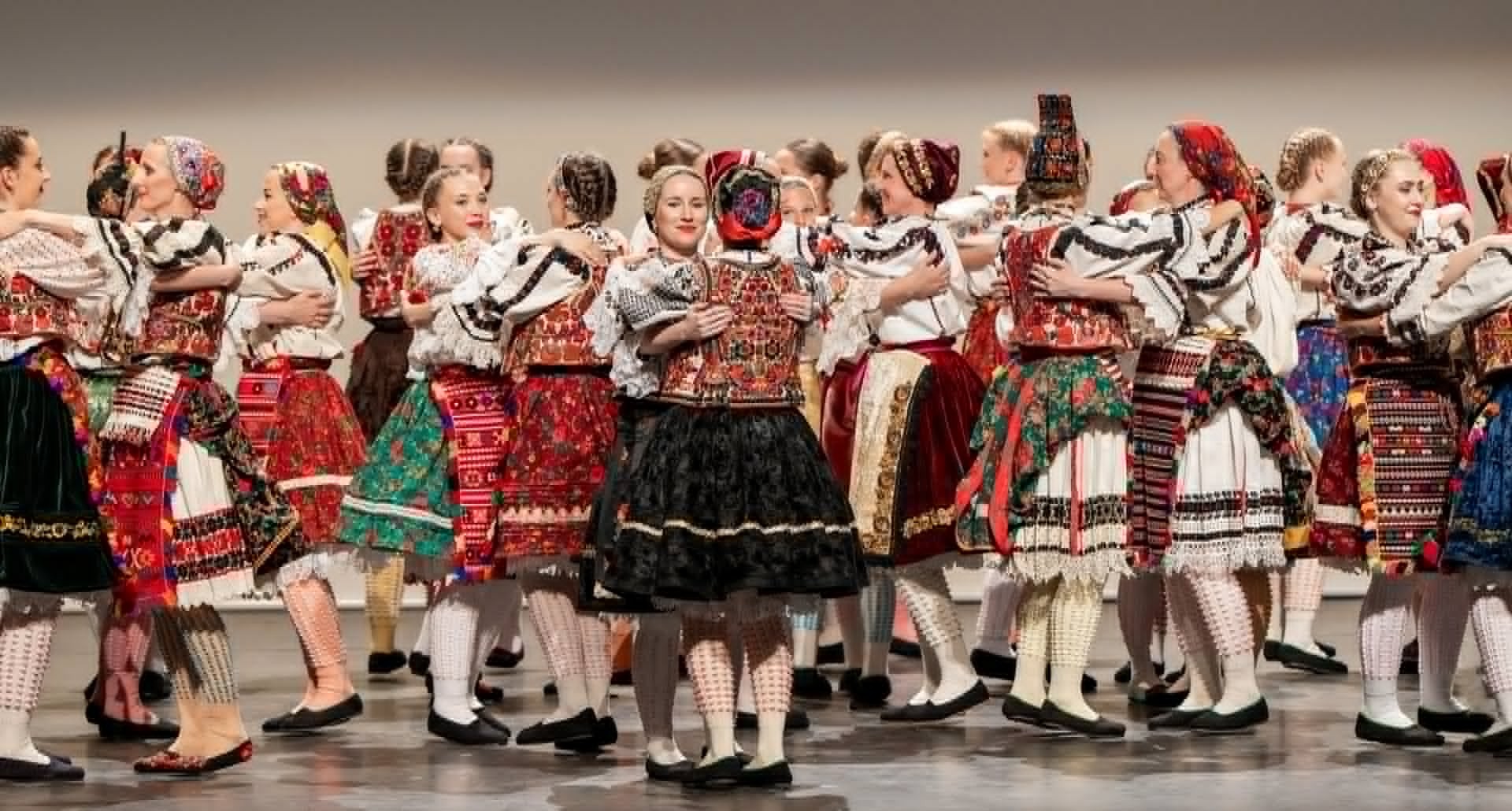
In 1989 the ensemble produced its first video film and began touring towns and villages across the country. Throughout its history, systematic documentation has been essential: photographs, videos, a website, books, calendars, CDs, and DVDs have all played a significant role. To date, the ensemble has given more than 900 performances, including appearances at the opening of the European Capital of Culture, at the National Theatre of Pécs, at the Kodály Centre, and at festivals in Croatia and along the Drava River at Easter.
A decisive turning point came in 1990, when Zoltán Farkas “Batyu” joined the ensemble. His first Lakócsa dance classes set the direction for future decades: a strong emphasis on artistic quality, authenticity, and dramaturgy. This collaboration has continued ever since, and choreographies inspired by Béla Bartók’s works (Allegro Barbaro, Romanian Folk Dances, 44 Violin Duos) are among the ensemble’s most important achievements.
Subsequent teachers—artists of remarkable talent and character—further strengthened the ensemble’s artistic philosophy: that authentic folk dance must be performed with the finest music, musicians, and dancers so that the message of a “golden age” and cultural origins can speak meaningfully to contemporary audiences.
From 1990 onward, the ensemble also began organizing dance camps and training courses in which thousands of participants—children, youth, and adults—learned dances, songs, and ethnographic knowledge. Preservation and transmission also take place through dance houses: since October 1988 the ensemble and its accompanying Vizin band have continuously held dance houses in Pécs.
Full evening performances have accompanied the ensemble from its earliest years and remain central to its work. Remarkably, within its first five years (by 1993), the ensemble had already premiered five full-length programs. Their titles reflect both artistic ambition and cultural depth: Those Who Are Still Here, referring to Ady’s poem, The Sky is Dark, a folk song from Kalotaszeg, In Search of Lost Time, echoing Proust, Southern Slavs, Beyond the River, a Croatian folk song and a reference to Hemingway, and From Autumn to Autumn (a review of folk customs).
The first anniversary gala was held at the Pécs National Theatre in 1993, followed by nine additional anniversaries (10th, 15th, 20th, 25th, 30th, 35th, and special thematic evenings, among which the Bartók-dedicated Message stands out).
In 1993 the ensemble reached the finals of the national talent competition, finishing second. In 1994 it toured the United States for ten days, performing in Washington, D.C., and New York.
When the biennial national qualification festivals were relaunched in 1996 with a maximum score of 150 points, Tanac competed in six rounds and earned six “excellent” ratings (one score of 144 and five scores of 146), usually placing first or second among all Hungarian folk dance ensembles. After 2006, having received the Martin György Memorial Plaque for the second time as recognition for three consecutive excellent titles, the ensemble chose to withdraw from competitions in order to pursue new artistic directions and focus on long-term sustainability. It made only two later exceptions, competing in the television show The Peacock Has Risen in 2012 and 2018.
For the ensemble’s leaders, minority identity and living folk traditions have always been defining experiences. It soon became evident that authenticity was a fundamental expectation, and that the traditions collected from elderly villagers possessed genuine cultural value—not merely material for stage adaptation. This approach requires a choreographer’s humility: stage forms must emerge from the original source material, while personal artistic ambition remains secondary. Interestingly, nearly all guest teachers over the decades have reinforced this ethos. Tanac is one of the few ensembles in Hungary to have created choreographies built on Bartók’s music.
The ensemble’s most cherished performances have always been those given in the villages from which its members originate. In some of these communities, Tanac’s program was—and sometimes still is—the only major cultural event of the year. Yet a single performance is never enough to sustain tradition. Regular dance lessons were launched in the villages, folk customs were revived (Carnival in Kátoly and Kásád; Spring traditions along the Drava; Pentecost in Szalánta; Midsummer in Felsőszentmárton; Nativity plays), and festivals, dance houses, and dance camps were established. Today, dozens of children’s, youth, and preschool groups continue this work.
The Association has published books, calendars, CDs, and DVDs, and its collections have been digitized and made publicly accessible online.
A special highlight is the international Croatian festival “Welcome, dear guest!”. The numbers are impressive: over 30 years, the festival has been held 24 times in Pécs, hosting more than 3,500 performers from 6 countries and 120 towns. During its Guinness World Record attempt, 850 people danced around Széchenyi Square in Pécs.
In November 2025, the ensemble received a certificate of recognition from the President of the Republic of Croatia in acknowledgement of its outstanding contribution to Croatian culture and heritage.